| Category | Terms covered |
|---|---|
| Head and face | 12 terms including formal register |
| Upper body | 12 terms including lima / nima distinction |
| Lower body | 7 terms with compound word breakdown |
| Internal organs | 8 terms for healthcare contexts |
| Sentence patterns | Pain, description, questions |
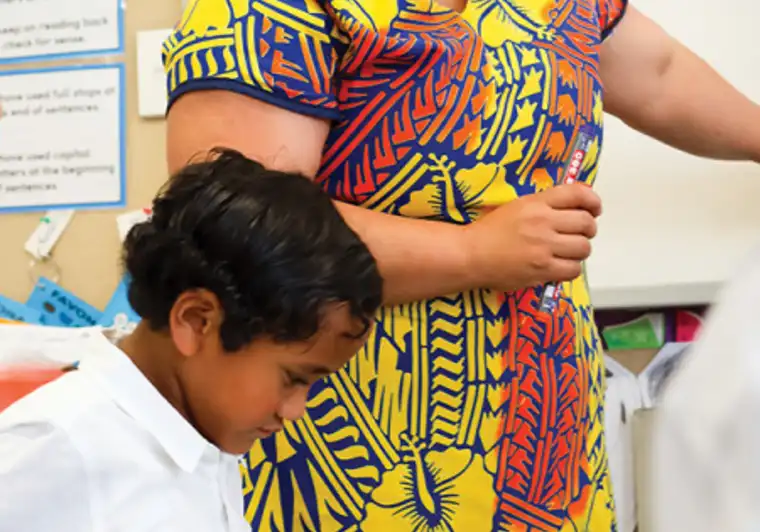
| Cultural notes | Ulu, pito, formal register for elders |
Body part vocabulary is one of the first practical sets any learner needs — for describing pain, talking about health, teaching children, or understanding traditional expressions. In Vagahau Niue, several body part terms carry meaning beyond anatomy: lima (hand) is also the word for five, mata (eye) appears in colour terms, and pito (navel) carries cultural weight shared across Polynesian traditions.
This guide covers head and face, upper body, lower body, and internal terms, with pronunciation notes, sentence examples using VSO structure, and the cultural context that makes these words more than a vocabulary list.
Head and Face Vocabulary
The head (ulu) and face (mata) are the most frequently referenced body areas in greetings, health conversations, and traditional expressions. Niuean, like other Polynesian languages, has a distinct formal register for face and head terms when addressing or referring to elders.
| Vagahau Niue | English | Notes |
|---|---|---|
| Ulu | Head | Used metaphorically for leadership; most sacred body part |
| Mata | Eye / Face | Root of lanumata (green) and matavae (foot) |
| Ihu | Nose | Shared root with Samoan ihu, Tongan ihu |
| Gutu | Mouth | Everyday register |
| Ngutu | Lips | More specific than gutu |
| Nifo | Tooth / Teeth | Singular and plural same form |
| Aleo | Tongue | |
| Taliga | Ear | Samoan taliga, Tongan telinga — shared Proto-Polynesian root |
| Lauulu | Hair (of head) | Lau (leaf/surface) + ulu (head) |
| Fofoga | Face (formal/respectful) | Used when referring to elders or in formal speech |
| Kautu | Forehead | |
| Kauae | Jaw / Chin |
On mata: This word does significant work in Vagahau Niue. As "eye," it appears in the colour term lanumata (green) — literally "the colour of the face of the plant," referring to the green of leaves. It also appears in matavae (foot — literally "face/front of the leg"). Recognising mata as a productive root helps decode compound terms across the vocabulary rather than treating each word as a separate item to memorise.
On fofoga: Vagahau Niue has a formal register for body parts when referring to elders or in ceremonial contexts. Fofoga (face, formal) replaces mata when speaking about or to a senior person. This register distinction reflects the same cultural logic as the formal greeting fakaalofa lahi atu — the language encodes respect structurally, not just through tone of voice.
Upper Body Vocabulary
The upper body terms in Vagahau Niue include several that appear in everyday phrases about work, strength, and family roles. The distinction between nima (arm) and lima (hand) is worth noting early — both appear frequently and are sometimes confused by learners coming from Samoan, where lima covers both.
| Vagahau Niue | English | Notes |
|---|---|---|
| Ua | Neck | |
| Tuha | Shoulder | |
| Fatafata | Chest / Breast | |
| Manava | Stomach / Belly / Womb | Context determines meaning |
| Pito | Navel / Belly button | Culturally significant across Polynesia |
| Keke | Armpit | |
| Nima | Arm | Distinct from lima (hand) |
| Lima | Hand | Also means "five" — counting on fingers |
| Maui | Left (side) | |
| Matau | Right (side) | |
| Nimo | Fingernail | Same word used for toenail |
| Ketu | Back (of body) |
On lima: Lima means both "hand" and "five" — a direct reference to counting on fingers. This dual meaning is shared with Hawaiian (lima) and Samoan (lima), and is cognate with Tongan nima. When you learn lima as a body part, you already know the number five. This kind of vocabulary overlap is worth tracking systematically: it reduces the total number of items to memorise and reveals the internal logic of the language.
On manava: This term covers stomach, belly, and womb depending on context. In broader Polynesian cultural usage, manava also carries the sense of inner strength, breath, and emotional centre — similar to how English uses "gut feeling" metaphorically. In Niuean expressions of wellbeing, manava can refer to emotional state, not just physical location. A sentence like E mamahi hoku manava could mean physical stomach pain or emotional distress depending on context.
On pito: The navel holds specific cultural significance across Polynesian traditions. In te reo Māori, pito refers to the navel and also to the concept of a centre point — pito o te ao (navel of the world). Niuean usage shares this cultural weight. The term appears in traditional narratives about origin and belonging, and in some Niuean families in New Zealand, the pito of a newborn is returned to Niue for burial as a way of establishing the child's connection to ancestral land.
Lower Body Vocabulary
Lower body terms are essential for health conversations, physical descriptions, and traditional activities like fishing and farming that remain part of Niuean cultural identity. The compound structure of knee, ankle, and foot terms makes them easier to learn once you know the base word vae.
| Vagahau Niue | English | Notes |
|---|---|---|
| Vae | Leg / Foot | Context distinguishes leg from foot |
| Tulivae | Knee | Tuli + vae — compound term |
| Nofovae | Ankle | Nofo (sit/rest) + vae |
| Matavae | Foot | Mata (face/front) + vae — "face of the leg" |
| Nimo | Toenail | Same word as fingernail |
| Ivi | Bone | Shared with Samoan ivi, Tongan ivi |
| Toto | Blood | Shared with Samoan toto, Tongan toto |
On compound terms: Tulivae (knee), nofovae (ankle), and matavae (foot) all use vae (leg) as a base. This compounding pattern — attaching a modifier to a body part root — appears throughout the vocabulary. Once you know the base terms, compound body part words become decodable rather than arbitrary. The same mata root that means "eye" in the face vocabulary means "front/face of" in matavae — the front surface of the leg, i.e., the foot.
Internal Organs and Medical Vocabulary
Healthcare workers in South Auckland who interact with Niuean patients — particularly first-generation migrants who may be more comfortable in Vagahau Niue — benefit from knowing these terms. The Niuean community in Māngere, Ōtara, and Papatoetoe includes a significant proportion of older adults for whom English is a second language. Counties Manukau (now part of Te Whatu Ora) serves this population directly.
| Vagahau Niue | English | Notes |
|---|---|---|
| Fatu | Heart | Appears in place names and cultural expressions |
| Manava | Stomach / Womb | See upper body notes |
| Ivi | Bone | |
| Toto | Blood | Shared with Samoan toto, Tongan toto |
| Sino | Body (whole) | The complete physical form |
| Mafu | Lung | |
| Ate | Liver | |
| Momoko | Kidney |
On fatu: The heart (fatu) appears in Niuean cultural expressions about courage and emotional strength, parallel to how English uses "heart" metaphorically. Fatu also appears in place names on Niue island. Knowing the word in its anatomical sense gives access to its metaphorical uses in traditional speech and song — a pattern that matters for NCEA Level 2 and 3 cultural analysis standards.
On sino: Sino (body, whole) is the term used when referring to the complete physical form rather than a specific part. It appears in health assessments, traditional healing contexts, and in expressions about physical wellbeing. E lelei hoku sino (My body is well) is a complete statement of health that goes beyond any single body part.
How Body Part Roots Appear in Broader Vocabulary
Several body part terms function as productive roots in compound words across the vocabulary. Tracking these connections reduces memorisation load and reveals the internal structure of the language.
| Body Part Root | Meaning | Appears In | Compound Meaning |
|---|---|---|---|
| Lima | Hand | Lima (five) | Counting on fingers |
| Mata | Eye / Face | Lanumata (green) | Colour of the leaf's face |
| Mata | Eye / Face | Matavae (foot) | Front/face of the leg |
| Vae | Leg | Tulivae (knee) | Compound: knee |
| Vae | Leg | Nofovae (ankle) | Compound: ankle |
| Vae | Leg | Matavae (foot) | Compound: foot |
| Ulu | Head | Lauulu (hair) | Leaf/surface of the head |
| Lau | Leaf / Surface | Lauulu (hair) | Leaf of the head |
This pattern — body part roots appearing in compound words — is a feature of Polynesian languages generally. In Vagahau Niue, learning body parts is not just vocabulary acquisition; it is learning a set of productive roots that unlock other words. A learner who knows mata, vae, ulu, and lima can decode a significant portion of compound vocabulary without additional memorisation.
Body Parts in Vagahau Niue Sentences
Vagahau Niue uses VSO word order — verb first, then subject, then object. Body part vocabulary appears most often in sentences about pain, health, and physical description. The particle system applies here exactly as elsewhere in the grammar.
Describing pain — structure: E mamahi hoku [body part]
| Vagahau Niue | English |
|---|---|
| E mamahi hoku ulu. | My head hurts. |
| E mamahi hoku vae. | My leg hurts. |
| E mamahi hoku nifo. | My tooth hurts. |
| E mamahi hoku manava. | My stomach hurts. |
| E mamahi hoku taliga. | My ear hurts. |
| E mamahi hoku fatu. | My heart hurts. |
| E mamahi hoku nima. | My arm hurts. |
E is the present tense marker. Mamahi means pain or hurts. Hoku means my. The body part follows. This three-part structure — particle + verb + possessive + noun — is consistent across all pain descriptions.
Asking about pain:
| Vagahau Niue | English |
|---|---|
| Ko fea e mamahi? | Where does it hurt? |
| E mamahi hoku ulu nakai? | Does my head hurt? (explicit question) |
| E lelei hoku sino. | My body is well. |
Describing physical features:
| Vagahau Niue | English |
|---|---|
| Ko lahi hona ulu. | His/her head is big. |
| Ko hinehina hona lauulu. | His/her hair is white. |
| Ko uliuli hona mata. | His/her eyes are dark/black. |
Hoku = my; hona = his/her/its. These possessive markers attach before the body part noun in the standard pattern.
Practical Priority List for Healthcare and Teaching Contexts
Not all body part terms are equally urgent. This priority ranking reflects frequency in healthcare interactions and early childhood teaching programmes in Māngere and Ōtara ECE centres.
| Priority | Vagahau Niue | English | Most Common Context |
|---|---|---|---|
| High | Mamahi | Pain / hurts | All health conversations |
| High | Ulu | Head | Headache, injury |
| High | Manava | Stomach | Digestive complaints |
| High | Fatu | Heart | Cardiac, emotional |
| High | Vae | Leg | Mobility, injury |
| High | Nima | Arm | Injury, blood pressure |
| High | Toto | Blood | Medical procedures |
| High | Sino | Body (whole) | General health |
| Medium | Ivi | Bone | Fracture, pain |
| Medium | Taliga | Ear | Infection, hearing |
| Medium | Mata | Eye | Vision, infection |
| Medium | Ihu | Nose | Respiratory |
| Medium | Nifo | Tooth | Dental pain |
| Lower | Mafu | Lung | Respiratory conditions |
| Lower | Ate | Liver | Specific conditions |
For parents teaching children body parts during Niue Language Week activities, the head and face terms (ulu, mata, ihu, gutu, taliga) are the standard starting sequence, following the same order used in early childhood education programmes.
Cultural Notes on the Body in Vagahau Niue
The body in Niuean cultural tradition is not treated as a purely individual possession. The extended family (magafaoa) has obligations around health, care, and physical wellbeing that extend across generations. Elders' bodies are treated with particular respect — the formal register for body parts (fofoga for face, rather than mata) reflects this structurally in the language.
Tapu (sacred prohibition) applies to certain body areas in traditional Niuean practice, as in other Polynesian cultures. The head (ulu) is considered the most sacred part of the body — touching someone's head without permission is a significant breach of protocol, particularly with elders. This principle applies across te reo Māori, Samoan, and Tongan cultural contexts as well, but it is not a shared rule — it is an independent cultural value that each tradition holds for its own reasons.
The pito (navel) carries specific significance as a point of origin and connection. In traditional practice, the burial of a child's pito in family land established belonging to a place. Some Niuean families in New Zealand maintain this practice, returning the pito to Niue. For a language learner, knowing this context means that pito is not just an anatomical term — it is a word that carries a specific cultural argument about where a person belongs.