| Feature | Detail |
|---|---|
| Word for song/chant | Hiva |
| Primary musical tradition | Himene (church hymns in Vagahau Niue) |
| Traditional instruments | Pate (slit drum), fangufangu (nose flute) |
| Adopted instruments | Ukulele, guitar |
| Key musical contexts | Church services, fono, Niue Language Week |
| Niue Language Week 2026 | 19–25 October 2026 |
| Main NZ communities | Māngere, Ōtara, Papatoetoe, Porirua |
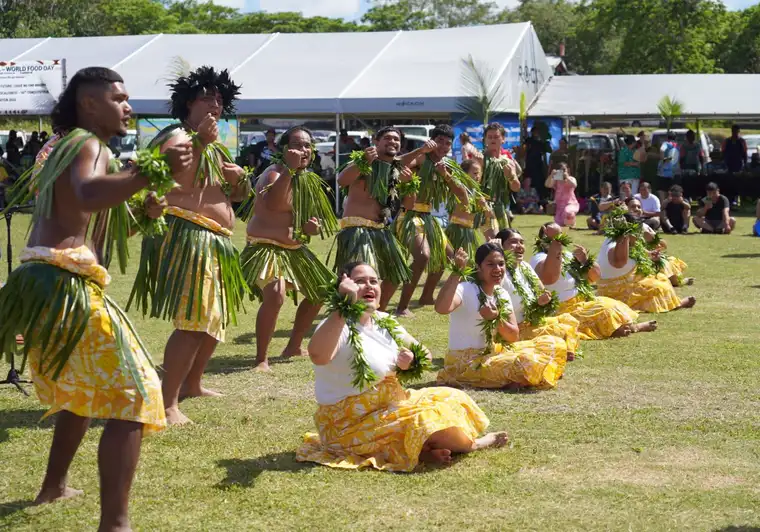
Music in Niuean culture is not a separate category from language, ceremony, or community life. Songs carry vocabulary, encode history, and mark the transitions of daily and ceremonial life. For learners of Vagahau Niue, music is one of the most effective entry points — not because it is easy, but because it provides context that isolated vocabulary lists cannot.
Hiva: The Niuean Word for Song
In Vagahau Niue, hiva means both "nine" (the number) and "song" or "chant." The same word covers both meanings — a coincidence of form that reflects how deeply music is woven into the language's basic vocabulary.
Traditional hiva were not entertainment in the modern sense. They were functional: used to mark ceremonies, transmit genealogies, signal community gatherings (fono), and accompany work. The content of a hiva could encode specific family histories or land relationships that would otherwise require lengthy spoken explanation.
The distinction between a hiva (song/chant) and a himene (hymn, from the English "hymn") is significant. Himene entered Niuean musical life through missionary contact from 1846 onward. Traditional hiva predate that contact and carry a different cultural register — one tied to pre-Christian ceremony and oral history rather than liturgy.
Traditional Instruments of Niue
Niue's traditional instrument set is small but shares features with broader Polynesian musical culture. Two instruments are distinctly traditional; two others arrived through colonial and missionary contact and are now dominant in everyday practice.
| Instrument | Vagahau Niue Name | Type | Primary Function |
|---|---|---|---|
| Slit drum | Pate | Percussion | Ceremonial signalling, rhythm |
| Nose flute | Fangufangu | Wind | Personal and courtship music |
| Ukulele | (loanword) | String | Community and contemporary music |
| Guitar | (loanword) | String | Church and contemporary music |
Pate
The pate is a hollowed log drum, struck with a stick. It appears across Polynesia under different names — pahu in some languages, lali in Fijian contexts. In Niue, the pate was used to signal community gatherings and to mark ceremonial occasions. The sound carries over distance, making it practical for island communication before modern technology.
The pate is not a melodic instrument. It produces rhythm and signal, not pitch. Its role in Niuean music is structural: it marks time and announces events rather than carrying melody. In contemporary Niuean cultural performances in New Zealand, the pate appears mainly in formal demonstrations and cultural events rather than in regular community music-making.
Fangufangu
The fangufangu is a nose flute — played by exhaling through one nostril while the other is closed, directing breath across a hole in the instrument. Nose flutes appear across Polynesia and Melanesia. In Niue, the fangufangu was associated with personal expression and courtship, played in informal rather than ceremonial contexts.
The instrument requires breath control that differs from mouth-blown flutes. It produces a soft, breathy tone. Few active players remain in New Zealand — the fangufangu is now more commonly seen in cultural demonstrations than in regular musical practice.
Ukulele and Guitar
Both instruments arrived through colonial and missionary contact. The ukulele — derived from the Portuguese machete brought to Hawaii in the 1880s — spread across the Pacific through trade and cultural exchange. By the mid-20th century it was ubiquitous in Niuean community music. The guitar followed a similar path.
Today, ukulele and guitar are the primary instruments in Niuean community music in New Zealand. They accompany himene in church, action songs in schools, and contemporary Pacific music by Niuean artists.
Himene: Church Hymns as the Dominant Musical Tradition
The London Missionary Society reached Niue in 1846, initially through Peniamina — a Niuean who had converted to Christianity in Samoa and returned to his island. Within decades, Christianity had restructured Niuean social life, and church music became the dominant musical form.
Himene are sung in Vagahau Niue in church services. The Niue Ekalesia — Niuean congregations affiliated with the Congregational Christian Church — holds services in multiple Auckland locations, including Māngere and Ōtara. Services are often conducted partly or fully in Vagahau Niue, with himene forming a central part of the liturgy.
For language learners, himene offer several practical advantages:
- Lyrics are in Vagahau Niue, providing extended exposure to the language in context
- Repetition within songs reinforces vocabulary and pronunciation
- The communal singing context is forgiving — you can listen and gradually join in
- Fluent elders are present and can correct pronunciation informally after the service
The hymn tradition also means that Vagahau Niue has a substantial body of written song texts — more than many endangered languages of comparable speaker size. These texts are a resource for learners who want reading practice beyond phrase cards.
Music and Language Transmission
Songs are among the most effective tools for transmitting endangered languages to younger generations. Melody and rhythm create memory hooks that isolated vocabulary does not. A child who learns a song in Vagahau Niue retains the vocabulary in that song more reliably than vocabulary learned from a list.
This is why early childhood education (ECE) centres in Māngere and Ōtara incorporate Vagahau Niue songs into their programmes, particularly during Niue Language Week. The New Zealand early childhood framework (Te Whāriki) explicitly supports Pacific language and cultural content.
| Age Group | Musical Context | Language Outcome |
|---|---|---|
| ECE (0–5) | Action songs, counting songs | Vocabulary, pronunciation patterns |
| Primary school | Niue Language Week performances | Phrases, cultural context |
| Secondary school | NCEA Vagahau Niue listening standards | Extended comprehension |
| Adults | Church himene, community events | Sustained exposure, fluency maintenance |
The risk is that music becomes a substitute for language rather than a pathway into it. Singing a song in Vagahau Niue without understanding the words produces phonetic imitation, not language acquisition. The most effective approach combines singing with explicit vocabulary work — learning what the words mean, not just how they sound.
Niuean Music in New Zealand
The Niuean community in New Zealand — approximately 25,000 people, concentrated in South Auckland and Wellington's Porirua — has developed a musical culture that blends traditional elements with contemporary Pacific sounds.
Contemporary Niuean music in New Zealand draws on:
- Gospel and church music traditions (himene)
- Pacific pop and R&B with Vagahau Niue lyrics
- Reggae and hip-hop with Pacific themes
- Action songs and children's music for community events
Niu FM, the Pacific radio station broadcasting across New Zealand, plays Niuean music and broadcasts Vagahau Niue content, particularly during Niue Language Week in October. RNZ Pacific also covers Niuean music and cultural events year-round.
The South Auckland community events circuit — church concerts, cultural festivals, community fundraisers — is where Niuean music is most consistently performed live. These events are not widely advertised outside the community, but the Niue Island Council of New Zealand can direct interested people to upcoming events.
Music During Niue Language Week
Niue Language Week (Te Wiki o te Vagahau Niue) runs 19–25 October 2026. Music is a consistent feature of the week's activities across all age groups and settings.
In schools and ECE centres:
- Action songs in Vagahau Niue are taught and performed
- Counting songs reinforce number vocabulary (taha, ua, tolu, fa, lima, ono, fitu, valu, hiva)
- Schools with Niuean student populations may hold cultural performances that include hiva
In community settings:
- Church services during the week often include additional himene
- Community concerts and cultural events in Māngere, Ōtara, and Porirua
- Hiapo-making groups (traditional Niuean quilting) often conduct sessions with music in the background — one of the few non-church contexts where Vagahau Niue is used in sustained conversation
In media:
- Niu FM and RNZ Pacific broadcast Niuean music content throughout the week
- The Ministry for Pacific Peoples (Manatū Moana) releases audio resources including songs — free and available after the week ends
The Ministry's audio resources are produced by fluent speakers and are phonetically accurate. For non-Niuean learners, these recordings are the most reliable starting point for hearing Vagahau Niue sung correctly.
Learning Vagahau Niue Through Songs
Songs provide vocabulary in context, but they require preparation to be useful for language learning rather than just phonetic repetition.
Effective approach:
1. Find the lyrics in Vagahau Niue — Ministry for Pacific Peoples resources and church song books are the most reliable sources 2. Get a word-for-word translation, not just a general meaning 3. Identify the grammar structures: tense markers (ne, ke, kua, e), VSO word order, particles 4. Listen to a recording by a fluent speaker before attempting to sing 5. Sing slowly, prioritising correct pronunciation over rhythm initially 6. Use macrons correctly — "mama" and "māmā" are different words
Vocabulary commonly found in Niuean songs:
| Vagahau Niue | English | Context |
|---|---|---|
| Hiva | Song / nine | Music, counting |
| Alofa | Love, compassion | Hymns, greetings |
| Fakaalofa | To extend love | Formal greeting, hymns |
| Fiafia | Happy, joyful | Celebration songs |
| Lelei | Good, fine | General positive expression |
| Tapu | Sacred | Church music, ceremonial songs |
| Tupuna | Ancestor / grandparent | Songs about heritage |
| Magafaoa | Extended family | Community songs |
| Pō | Night / evening | Evening songs, lullabies |
| Aho | Day | Songs about time and seasons |
| Tofa soifua | Farewell | Closing songs, farewells |
| Fono | Community gathering | Songs marking collective events |
Songs that use these words give learners high-frequency vocabulary in a memorable context. The word alofa — love, compassion — appears in himene, in the greeting fakaalofa, and in everyday speech. Encountering it in a song reinforces its meaning across multiple contexts simultaneously.
Contemporary Niuean Music and Identity
For New Zealand-born Niueans, music is one of the primary ways Pacific identity is expressed and maintained. The second and third generations — who often have passive rather than active competence in Vagahau Niue — use music as a connection point to heritage that does not require full fluency.
This creates a specific dynamic: contemporary Niuean music in New Zealand often mixes English and Vagahau Niue within the same song. A verse in English, a chorus in Vagahau Niue. This code-switching reflects the actual linguistic reality of the community — it is not a compromise, it is an accurate representation of how language lives in a diaspora context.
For learners, this mixed-language music is useful precisely because it provides Vagahau Niue in a context where the English meaning is often clear from the surrounding lyrics. It is a lower-barrier entry point than fully Vagahau Niue himene.
The cultural weight of music in Niuean identity also explains why performing or engaging with Niuean music during Niue Language Week — even at a basic level — is received positively by the community. It signals engagement with Niuean culture as distinct from Samoan, Tongan, or Cook Islands Māori cultures, which matters in a New Zealand context where "Pacific" is often treated as a single undifferentiated category.