| Feature | Detail |
|---|---|
| Dominant religion | Christianity (over 90% of Niueans) |
| Largest denomination | Ekalesia Niue (Congregational tradition) |
| First missionary contact | 1846, via Peniamina |
| Missionary society | London Missionary Society (LMS) |
| Sunday in Vagahau Niue | Aho Tapu (sacred day) |
| Saturday in Vagahau Niue | Tāpati (from "Sabbath") |
| Key religious concept | Tapu (sacred / forbidden) |
| Church language in NZ | Vagahau Niue used in services |
| Niue Language Week 2026 | 19–25 October 2026 |
Christianity arrived on Niue in 1846 and reshaped every aspect of Niuean life within a generation. Today, over 90% of Niueans identify as Christian, and the church remains the primary institution where Vagahau Niue is spoken in sustained conversation — both on the island and in New Zealand's South Auckland diaspora. Understanding Niuean religion means understanding how a Polynesian belief system, a Congregational missionary tradition, and a language at risk of decline became inseparable.
How Christianity Came to Niue: Peniamina and 1846
The London Missionary Society did not send a European missionary to Niue first. Initial contact came through Peniamina — a Niuean man who had converted to Christianity while living in Samoa, where the LMS had been active since the 1830s. He returned to Niue in 1846 with the intention of spreading the faith to his own people.
His reception was not immediate. Niueans had repelled earlier European contact — Captain James Cook's 1774 attempt to land was refused, earning the island the name "Savage Island" on European maps. Peniamina faced resistance, but persisted. By the 1860s, the LMS had established a formal mission on Niue. By the 1880s, Christianity was the dominant religion across the island.
The speed of conversion was not unusual for the Pacific. What was distinctive about Niue was the role of a Niuean convert — not a European missionary — as the primary agent of change. Peniamina's name is still recognised in Niuean cultural memory.
The LMS brought Congregationalism: a form of church governance where each congregation is self-governing, with no bishop or central hierarchy. This structure aligned with existing Niuean fono (council/assembly) traditions, where community decisions were made collectively. The fit was not accidental — LMS missionaries across the Pacific often worked with, rather than against, existing governance structures.
The Ekalesia Niue: Structure and Reach
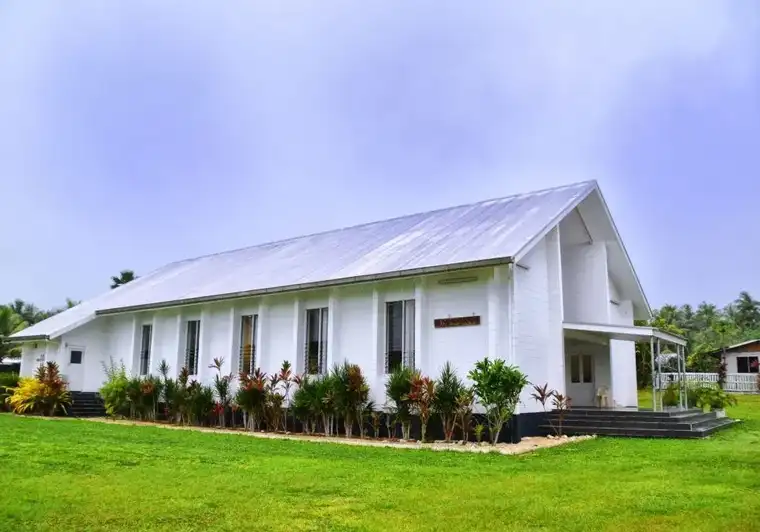
The Ekalesia Niue (Niue Church) is the direct descendant of the LMS mission. It is affiliated with the Congregational Christian tradition and is the largest religious institution on Niue island and in the Niuean diaspora.
On Niue island, the Ekalesia Niue operates across multiple village congregations. The church functions as a community centre, a venue for fono (community meetings), and a space where cultural practices including hiapo-making and language use are maintained.
In New Zealand, Niue Ekalesia congregations operate in:
- Māngere (South Auckland) — the largest Niuean community in New Zealand
- Ōtara (South Auckland)
- Papatoetoe (South Auckland)
- Porirua (Wellington region)
- Hutt Valley (Wellington region)
These congregations conduct services partly or fully in Vagahau Niue. For New Zealand-born Niueans, the church service is often the primary context in which they hear sustained spoken Vagahau Niue — more so than family conversations, which frequently shift to English.
Religious Denominations on Niue
| Denomination | Approximate share (Niue island) | Notes |
|---|---|---|
| Ekalesia Niue (Congregational) | ~67% | Largest denomination; LMS origin |
| Seventh-day Adventist | ~9% | Observes Saturday Sabbath |
| Roman Catholic | ~5% | Smaller presence; arrived later than LMS |
| Other Christian | ~10% | Includes various Protestant groups |
| No religion / not stated | ~9% | Growing among younger generations |
The Seventh-day Adventist presence on Niue creates a different relationship with the calendar. SDA members observe Saturday as the Sabbath, while the Ekalesia Niue observes Sunday (Aho Tapu). Both groups use the Vagahau Niue term tapu (sacred) in their religious vocabulary, but apply it to different days.
In New Zealand, the denominational breakdown among Niueans broadly mirrors the island pattern, with the Ekalesia Niue remaining dominant.
Tapu, Aho Tapu, and the Sacred in Vagahau Niue
The word tapu is one of the most significant in Vagahau Niue — and one of the most widely exported. English borrowed "taboo" from Polynesian languages in the 18th century, through contact with Tonga and Tahiti. The Niuean form, tapu, carries the same core meaning: sacred, forbidden, set apart.
In Niuean religious practice, tapu applies most visibly to Sunday. Aho Tapu — literally "sacred day" — is the Vagahau Niue word for Sunday. The Christian Sabbath merged with the pre-existing Polynesian concept of sacred prohibition. On Niue island, Sunday observance remains strict: most businesses close, recreational activities are restricted, and the day is reserved for church attendance and family.
Saturday is Tāpati in Vagahau Niue — a direct borrowing from "Sabbath" via English and missionary contact. The word entered the language through the LMS period and has remained. This is one of several loanwords that mark the missionary era in Vagahau Niue vocabulary.
The concept of tapu predates Christianity on Niue. In traditional Polynesian belief systems, tapu designated people, objects, or places as sacred and therefore off-limits to ordinary contact. Chiefs, ritual specialists, and certain natural sites carried tapu status. Christianity did not erase this concept — it absorbed it, redirecting the sacred prohibition toward the Sabbath and Christian ritual.
Pre-Christian Belief: Aitu and Ancestor Veneration
Before 1846, Niueans held a belief system centred on aitu — spirits or supernatural beings — and ancestor veneration. The tupuna (grandparent/ancestor) was not simply a deceased relative but a continuing presence in family and community life. This is reflected in the Vagahau Niue language itself: the same word, tupuna, covers both "grandparent" and "ancestor," with no linguistic distinction between the living and the dead.
Ritual specialists (taula aitu) mediated between the human and spirit worlds. Village-level ceremonies marked agricultural cycles, fishing seasons, and significant life events. The fono (community council) had both political and ritual functions.
Christianity largely displaced these practices by the late 19th century. However, the underlying cultural logic — that ancestors remain present in family decisions, that certain places and times carry sacred weight, that community assembly has a ritual dimension — persisted within the Christian framework. The Ekalesia Niue's Congregational structure, with its emphasis on community governance, provided a space where these values could continue.
Some Niuean families maintain awareness of aitu traditions in cultural memory, even without active practice. This is not unusual in the Pacific — Christianity and pre-Christian cultural frameworks often coexist in layered form.
Religious Vocabulary in Vagahau Niue
| Vagahau Niue | English | Notes |
|---|---|---|
| Tapu | Sacred / forbidden | Source of English "taboo" |
| Aho Tapu | Sunday | Literally "sacred day" |
| Tāpati | Saturday | From "Sabbath" via English |
| Atua | God | Used in Christian and pre-Christian contexts |
| Lotu | Prayer / worship / church service | Core religious term across Pacific languages |
| Fakaalofa | Love / compassion / greeting | Central to Christian teaching; also the formal greeting |
| Tupuna | Grandparent / ancestor | Reflects continuity between living and dead |
| Aitu | Spirit / supernatural being | Pre-Christian; persists in cultural memory |
| Fono | Meeting / council / assembly | Community governance; integrated into church structure |
| Ekalesia | Church / congregation | From Greek ekklesia via English |
| Himi | Hymn | Loanword from English "hymn" |
| Lotu tapu | Holy worship / sacred service | Formal religious service |
The word lotu entered Pacific languages through missionary contact and is now used across Samoan, Tongan, and Fijian to mean prayer, worship, or church service. In Vagahau Niue, lotu is the everyday word for a church service or act of worship.
Atua (God) predates Christianity in Niuean vocabulary — it referred to supernatural beings or deities in the pre-Christian belief system. The LMS missionaries adopted the existing word for their monotheistic God, a common strategy across the Pacific. This means atua now carries both its pre-Christian meaning (in cultural and historical contexts) and its Christian meaning (in religious contexts).
Church as Language Preservation Space in New Zealand
The Niue Ekalesia congregations in South Auckland are the single most effective context for hearing sustained spoken Vagahau Niue in New Zealand. Church services in Māngere and Ōtara are often conducted partly or fully in Vagahau Niue. Hymns are sung in the language. Prayers, readings, and sermons may be delivered in Vagahau Niue, with English used for announcements or for the benefit of younger attendees.
This code-switching is itself a reflection of the language's situation: fluent elders, partially fluent middle generations, and English-dominant younger generations all present in the same space.
The church also functions as a venue for:
- Hiapo-making groups (traditional Niuean quilting, often conducted in Vagahau Niue)
- Fono (community meetings, sometimes bilingual)
- Cultural events during Niue Language Week
- Funeral and memorial services (conducted primarily in Vagahau Niue)
Funeral services are particularly significant. They are one of the few occasions when New Zealand-born Niueans with limited active language use are immersed in sustained Vagahau Niue for several hours. Elders deliver eulogies, prayers, and hymns in the language. For second and third-generation Niueans, funerals are often described as the most intense language exposure they receive outside of formal learning.
For language learners, attending a Niue Ekalesia service is the most direct route to hearing the language used naturally by fluent speakers. Community members generally welcome respectful visitors, particularly during Niue Language Week (19–25 October 2026).
Sunday Observance on Niue Island
Niue island's Sunday observance is one of the most immediately noticeable aspects of life there for visitors. Businesses close. The harbour is quiet. The roads are largely empty. Church attendance is high — Ekalesia Niue services draw a significant proportion of the island's approximately 1,500 residents.
Sunday observance on Niue reflects a genuine integration of Christian practice into Niuean cultural identity. The island's small size means that community norms are visible and enforced through social expectation rather than law. The tapu of Sunday is not a legal restriction — it is a cultural one, maintained by the community itself.
For the diaspora in New Zealand, Sunday observance is less uniform. The pressures of work, school schedules, and urban life make strict observance harder to maintain. But church attendance on Sunday remains significantly higher among Niueans in New Zealand than in the general New Zealand population, and the Ekalesia Niue congregations in South Auckland draw consistent weekly attendance.