| Feature | Detail |
|---|---|
| Topic | Food vocabulary in Vagahau Niue |
| Language | Vagahau Niue (niu) |
| Audience | New Zealand learners, Niuean diaspora, Pacific language students |
| Key terms | Kai, ika, niu, talo, uga, lolo, umu |
| Cultural context | Coral island diet, umu feasts, fono gatherings |
| Niue Language Week 2026 | 19–25 October 2026 |
Food vocabulary in Vagahau Niue is not a neutral word list — it maps what Niue's geography, ecology, and social structure actually look like. Niue is a raised coral island (makatea), with thin, porous soil that limits agriculture severely. The traditional diet reflects that constraint directly: seafood, coconut, taro, and breadfruit dominate, with imported foods filling gaps the land cannot provide.
The word for food and the word for eating are the same: kai. This double function appears in everyday phrases, dish names, and compound terms. Understanding kai as both noun and verb is the first practical step in Niuean food vocabulary.
Core Food Vocabulary: Quick Reference
The table below covers the highest-frequency food terms in Vagahau Niue. These appear in recipes, community feast contexts, and everyday conversation.
| Vagahau Niue | English | Notes |
|---|---|---|
| Kai | Food / to eat | Both noun and verb |
| Inu | To drink | |
| Vai | Water | |
| Talo | Taro | Primary starch crop |
| Niu | Coconut | Also the island's name |
| Mei | Breadfruit | Seasonal staple |
| Kumala | Sweet potato | |
| Ufi | Yam | |
| Fua | Fruit / banana | Context-dependent |
| Ika | Fish | General term for all fish species |
| Uga | Coconut crab | Culturally significant; regulated harvest |
| Feke | Octopus | |
| Mago | Shark | |
| Tuna | Freshwater eel | False cognate — not canned tuna |
| Kehe | Crayfish / rock lobster | |
| Pua | Pig / pork | Traditional feast meat |
| Moa | Chicken | |
| Lolo | Coconut cream | Used in most traditional dishes |
| Umu | Earth oven | The method and the structure |
| Humu | To cook | General cooking verb |
| Tunu | To roast / grill | Over open fire |
| Ota | Raw | As in ika ota (raw fish) |
Staple Ingredients
Niue's raised coral geology means no rivers and limited flat agricultural land. Traditional cultivation focused on crops that tolerate rocky, porous soil — and the vocabulary reflects exactly those crops.
Talo (taro) is the primary starch. It is grown in taro pits — depressions dug into the coral rock where soil accumulates over time. Both the corm and the leaves (lau talo) are used in cooking. Taro leaves appear in palusami; the corm is boiled, baked, or grated for dishes like takihi.
Niu (coconut) is so central to Niuean life that the island's name may derive from it. The coconut provides drinking water (vai niu), cream (lolo) for cooking, flesh for eating, and oil. Lolo appears in nearly every traditional Niuean dish — it is the cooking fat, the sauce, and the dessert base.
Mei (breadfruit) is seasonal, fruiting in summer. Historically it was preserved by fermentation or drying. In Vagahau Niue, mei refers to both the tree and the fruit.
| Ingredient | Vagahau Niue | How It Is Used |
|---|---|---|
| Taro corm | Talo | Boiled, baked, grated for takihi |
| Taro leaf | Lau talo | Wrapped around fillings, baked in umu |
| Coconut | Niu | Flesh, cream, water |
| Coconut cream | Lolo | Cooking liquid, sauce, dessert base |
| Coconut water | Vai niu | Drinking, from young coconuts |
| Breadfruit | Mei | Baked, boiled, fermented |
| Sweet potato | Kumala | Boiled, baked |
| Yam | Ufi | Boiled, baked |
| Banana | Fua | Eaten raw; used in poke dessert |
Seafood Vocabulary
Niue's Exclusive Economic Zone covers approximately 390,000 km² — one of the largest per capita in the Pacific. The island declared itself a World Heritage Island in 2008, with sustainable fishing as a core commitment. Seafood has always been the primary protein source, and the vocabulary for it is correspondingly specific.
| Vagahau Niue | English |
|---|---|
| Ika | Fish (general) |
| Uga | Coconut crab (Birgus latro) |
| Feke | Octopus |
| Mago | Shark |
| Tuna | Freshwater eel |
| Kehe | Crayfish / rock lobster |
On tuna: In Vagahau Niue, tuna means freshwater eel — a species found in Niue's cave pools and coastal waters. This is a false cognate for English speakers who associate "tuna" with canned fish. The eel carries cultural significance in Polynesian mythology across multiple island groups. Do not use tuna to mean the canned product in conversation with Niuean speakers.
On uga: The coconut crab is the largest land invertebrate on Earth, reaching up to 4 kg. On Niue, it is both a food source and a cultural symbol. Harvesting is regulated — size limits apply, and community norms around sustainable collection predate formal regulation. Knowing the word uga and its cultural weight is a genuine marker of engagement with Niuean culture, not just vocabulary acquisition.
Meat and Protein Terms
Pork (pua) is the traditional feast meat, prepared in the umu for community gatherings. Chicken (moa) is more common in everyday cooking. Beef (povi) is a loanword reflecting introduced cattle — the word derives from the English/French "bovine."
| Vagahau Niue | English |
|---|---|
| Pua | Pig / pork |
| Moa | Chicken |
| Povi | Beef / cattle |
Traditional Niuean Dishes
These dishes appear at community feasts, church gatherings, and family events. Several are shared across Polynesia under different names; others are specifically Niuean.
| Dish | Vagahau Niue Name | Description |
|---|---|---|
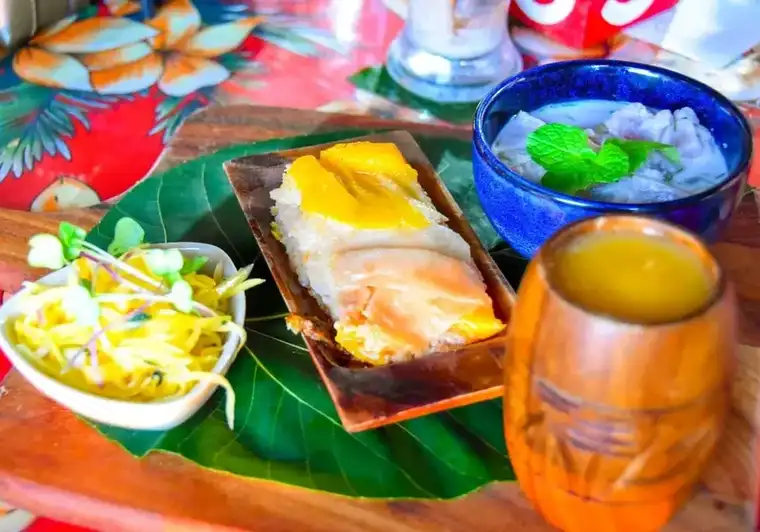
| Raw fish in coconut cream | Ika mata | Fresh fish marinated in lime, mixed with lolo and vegetables |
| Taro and coconut cream bake | Takihi | Grated taro baked with lolo — dense, slightly sweet |
| Banana dessert | Poke | Mashed banana or taro with lolo, baked until set |
| Coconut cream pudding | Kalolo | Coconut cream thickened with starch, served warm or cold |
| Taro leaves with coconut cream | Palusami | Lau talo wrapped around lolo and onion, baked in umu |
| Earth oven feast | Umu kai | Full meal cooked in the umu — pork, fish, taro, breadfruit |
Takihi is specifically Niuean — it does not appear under the same name in Samoan or Tongan cooking. The dish uses grated taro (not pounded), which gives it a different texture from poi or similar preparations. It is a standard item at community feasts.
Poke in Niuean cooking is not the Hawaiian poke bowl. The Niuean poke is a baked dessert — banana or taro mashed with coconut cream and arrowroot, then baked until firm. The name is shared across Polynesia but the dish is different. Do not assume the Hawaiian version when you see the word in a Niuean context.
Kalolo is a coconut cream pudding that appears at feasts and celebrations. It is made by cooking lolo with starch (taro or arrowroot) until it thickens. Traditionally served in coconut shells or banana leaves.
Ika mata is the most widely known Niuean seafood preparation. The name breaks down as ika (fish) + mata (raw). The dish is similar to Fijian kokoda and Samoan oka, reflecting a shared Polynesian technique for preparing fresh fish without heat. The Niuean version uses local fish species and lolo — no soy sauce, no sesame oil.
Cooking Methods and Verbs
Vagahau Niue uses VSO word order for cooking phrases, as with all sentences. The verb comes first: E humu ia he talo (She/he cooks the taro). Tense particles apply normally — ne humu (cooked, past), ke humu (will cook, future).
| Vagahau Niue | English | Context |
|---|---|---|
| Kai | Eat | Also means "food" |
| Inu | Drink | |
| Humu | Cook | General term |
| Tunu | Roast / grill | Over open fire |
| Umu | Earth oven | The method and the structure |
| Ota | Raw | Ika ota = raw fish |
| Mafana | Warm / hot | Describes food temperature |
The umu is a pit dug in the ground, lined with stones heated by fire. Food is wrapped in banana or taro leaves, placed on the hot stones, covered with more leaves and earth, and left to cook for several hours. The same method is called hangi in te reo Māori and imu in Hawaiian. The umu is used for community feasts and special occasions — not everyday cooking. Everyday cooking uses conventional stoves.
Coconut: The Central Ingredient
The word niu appears in the island's name and in the language's most important cooking ingredient. Understanding coconut vocabulary unlocks a significant portion of Niuean food culture, because lolo appears in nearly every traditional dish.
| Term | Vagahau Niue | Notes |
|---|---|---|
| Coconut (general) | Niu | Also the island's name |
| Coconut cream | Lolo | Extracted from grated mature coconut |
| Coconut water | Vai niu | From young coconuts; vai = water |
| Coconut crab | Uga | Feeds on coconuts; culturally significant |
| Coconut leaf | Lau niu | Used for weaving and wrapping food |
| Mature coconut | Niu motu | Used for lolo extraction |
Lolo is made by grating mature coconut flesh and squeezing the liquid through cloth. The first pressing produces thick cream; subsequent pressings produce thinner milk. Thick lolo is used in desserts like kalolo and poke. Thinner lolo is used in savoury dishes like takihi and palusami. The distinction between thick and thin lolo matters in traditional recipes — using the wrong consistency changes the texture of the finished dish.
Food Phrases for Conversation
These phrases follow the VSO grammar structure of Vagahau Niue. The tense particle comes before the verb; the subject follows the verb.
| Vagahau Niue | English |
|---|---|
| E fia ke kai? | Do you want to eat? |
| Kua kai au | I have eaten |
| E fia ke inu? | Do you want to drink? |
| Kai lelei! | Good food! / Delicious! |
| Ko fe he kai? | What is the food? |
| E fia ke kai he ika? | Do you want to eat fish? |
| Ne kai au he talo | I ate taro |
| Ke kai taua | Let's eat (inclusive — you and I both) |
| Nakai e kai au he pua | I do not eat pork |
| E mafana he kai | The food is warm |
| Fakaaue he kai | Thank you for the food |
On "Ke kai taua": The inclusive "we" (taua) is used here — it includes the person you are speaking to. Using maua (exclusive "we") would exclude the listener from the group. In a culture where sharing food is a social act, using the wrong pronoun is a meaningful error, not a minor slip. The inclusive/exclusive distinction covered in the grammar guide applies directly to food-sharing contexts.
Food at Community Gatherings
Food in Niuean culture is inseparable from the fono — the community gathering or council. Feasts mark births, deaths, marriages, church events, and community decisions. The umu is prepared communally, with specific roles assigned by age and family position.
| Vagahau Niue | English |
|---|---|
| Fono | Community gathering / council / feast |
| Umu kai | Earth oven feast |
| Kai fono | Feast food / food for the gathering |
| Magafaoa | Extended family (organises the feast) |
| Matua | Elder / parent (directs umu preparation) |
At a traditional fono, the sequence of food preparation and serving follows social hierarchy. Elders (matua) and guests are served first. The umu is managed by experienced cooks — typically older men and women who know the timing for different foods. Taro takes longer than fish; pork takes longer than chicken. The order of placement in the umu reflects this.
In New Zealand, umu feasts occur at Niuean community events, particularly during Niue Language Week (19–25 October 2026) and at church gatherings in Māngere, Ōtara, and Porirua. These events are the most accessible context for non-Niueans to encounter traditional food preparation in practice.