| Feature | Detail |
|---|---|
| Primary term | Hiva (song, chant, performance) |
| Language | Vagahau Niue |
| Main performance contexts | Fono, church services, Polyfest, Niue Language Week |
| Niue Language Week 2026 | 19–25 October 2026 |
| ASB Polyfest | March annually, Manukau Sports Bowl, Auckland |
| Key NZ communities | Māngere, Ōtara, Papatoetoe, Porirua |
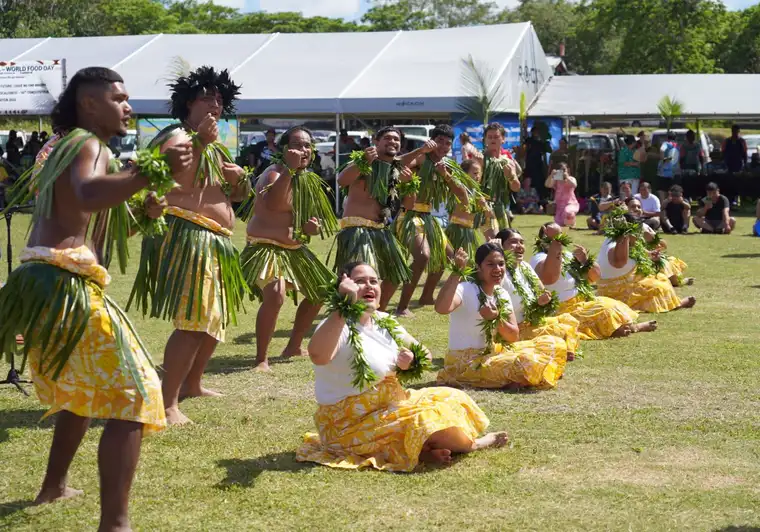
| Costume elements | Tapa cloth, pandanus weaving, shell ornaments |
| Music | Chant, hand percussion, ukulele, guitar |
| Coordinating body (NZ) | Niue Island Council of New Zealand |
Niuean dance is not a performance art in the Western sense. It is oral history, social obligation, and cultural identity compressed into movement and song. In New Zealand, where roughly 25,000 Niueans live compared to approximately 1,500 on the island itself, dance has become one of the primary ways the community maintains cultural continuity across generations.
This guide covers the core forms, their cultural logic, the music and costume that accompany them, and where to encounter Niuean dance in New Zealand in 2026.
What "Hiva" Means in Vagahau Niue
The word hiva in Vagahau Niue carries two meanings: the number nine, and the act of singing or performing. This dual meaning reflects a broader Polynesian pattern in which counting, recitation, and the transmission of knowledge are bound together.
In performance contexts, hiva refers to the combination of song, chant, and movement that characterises Niuean cultural performance. There is no clean separation between "dance" and "song" in the Niuean tradition — the two are a single form. A performer who moves without singing, or sings without moving, is doing something incomplete.
This integration distinguishes Niuean performance from Western dance traditions, where choreography and music are typically created separately and then combined.
Core Performance Forms
Niuean dance encompasses several distinct forms, each tied to a specific social context. The form chosen for a given occasion signals the nature of the event and the relationship between performers and audience.
| Form | Context | Characteristics |
|---|---|---|
| Hiva fakaalofa | Greeting ceremonies, formal gatherings | Slow, dignified; arm and hand movements primary |
| Hiva tau | Community celebrations, feasts | More energetic; group coordination central |
| Hiva taoga | Ceremonial occasions; transmission of cultural knowledge | Chant-heavy; movements encode specific meanings |
| Seated performance | Church services, indoor gatherings | Upper body and hand movements only |
| Standing group performance | Polyfest, outdoor events, Niue Language Week | Full body; formations and synchronisation |
Hiva fakaalofa — derived from alofa (love, compassion) with the causative prefix faka- — is the most formally significant form. It is performed at the start of major gatherings, at the arrival of guests, and at events where the community is formally welcoming someone. The movements are deliberate and slow, with the hands and arms doing most of the expressive work.
Hiva tau is performed at celebrations: feasts, weddings, community milestones. The energy is higher, the group coordination more visible, and the performance more accessible to younger participants who may not yet have the full cultural knowledge required for ceremonial forms.
Hiva taoga — taoga meaning treasure or cultural heritage — is the most knowledge-intensive form. It encodes genealogy, historical events, and place-specific knowledge in its lyrics and gesture sequences. This is the form most at risk of loss when transmission chains between generations break.
Hand Movements and What They Encode
In Niuean dance, the hands are the primary storytelling instrument. This is consistent across Polynesian dance traditions — from Hawaiian hula to Tongan lakalaka — but each tradition has its own gesture vocabulary, and Niuean gestures are not interchangeable with those of other Pacific cultures.
Niuean hand movements encode:
- Place — gestures indicating specific locations: the island, the sea, a named village
- Relationship — movements describing family connections and social roles
- Action — gestures representing fishing, planting, building, travelling
- Emotion — movements expressing grief, joy, longing, welcome
The gesture vocabulary is transmitted through direct teaching, not written notation. The knowledge lives in people — in elders who learned from their own elders — and is at risk when those transmission chains break. Community dance groups in Māngere and Ōtara are the primary sites in New Zealand where this transmission continues.
A learner watching a Niuean performance without context sees coordinated movement. A Niuean elder watching the same performance reads a text — specific words, names, and events encoded in the sequence of gestures.
Music: Instruments and Structure
Traditional Niuean music uses percussion and voice as its foundation, with the human voice — in unison chant or call-and-response — as the primary instrument. The structure of a performance is built around the chant, not around instrumental accompaniment.
| Instrument / Element | Role |
|---|---|
| Voice (chant) | Primary melodic and rhythmic element |
| Hand clapping | Rhythmic foundation in group performance |
| Log drum (pate) | Percussion; marks phrase boundaries |
| Ukulele | Common in contemporary community performance |
| Guitar | Introduced through missionary contact; standard in church-influenced performance |
The London Missionary Society's arrival in 1846 — initially through Peniamina, a Niuean convert who returned from Samoa — introduced hymn structures that permanently shaped Niuean musical performance. Contemporary Niuean community music blends traditional chant structures with hymn-influenced harmonies. This is not dilution — it is the actual historical form of the music as practiced for over 170 years.
At Polyfest and Niue Language Week events, performances typically use a combination of traditional chant and ukulele or guitar accompaniment. A cappella chant performances are rarer in public settings but remain the form used in more ceremonial contexts.
Costume and Visual Elements
Niuean performance costume draws on materials and colours with specific cultural meaning, and a knowledgeable observer can read a performer's family and regional origin from the design elements of their costume.
| Element | Material / Description | Significance |
|---|---|---|
| Skirt (women) | Pandanus leaf weaving, fabric adaptations | Pandanus is central to Niuean material culture |
| Waist wrap (men) | Tapa cloth or fabric equivalent | Tapa-making is a traditional skill; now rare on the island |
| Shell ornaments | Cowrie shells, pearl shell | Indicate status and connection to the ocean |
| Flower garlands | Fresh flowers, fabric flowers | Worn at neck and head; signal celebration |
| Colour palette | Yellow, white, natural fibre tones | Yellow appears in Niue's national flag; white signals formality |
Tapa cloth — made from the beaten bark of the paper mulberry tree — was the traditional fabric of Niuean ceremonial dress. On Niue island, tapa-making has largely ceased as a living practice. In New Zealand, fabric equivalents are used in performance costume, with some community groups maintaining tapa-making knowledge through workshops.
The hiapo tradition — Niuean decorative cloth-making, now expressed primarily as quilting — uses geometric patterns that also appear in performance costume design. Hiapo patterns are family-specific and region-specific. A costume's design can identify the performer's family and village of origin to a knowledgeable observer, making costume a form of genealogical statement as well as visual presentation.
Niuean Dance in New Zealand: Where It Happens
The Niuean community in New Zealand maintains dance practice through three main institutional channels: church, school competition, and community organisations. Each channel reaches a different segment of the community and operates on a different calendar.
Church Services (Niue Ekalesia)
The Niue Ekalesia — Niuean congregations affiliated with the Congregational Christian Church — holds services in multiple Auckland locations, primarily in Māngere and Ōtara. Services are often conducted partly or fully in Vagahau Niue and include hymn singing with movement. This is the most consistent, year-round context for Niuean cultural performance in New Zealand.
Church services are not closed events. Community members generally welcome respectful visitors, particularly during Niue Language Week in October.
ASB Polyfest
The ASB Polyfest is held annually in Auckland, typically in March, at Manukau Sports Bowl. It is the largest secondary school Pacific cultural festival in the world by participation. Niuean groups compete at the Niue stage alongside groups from other Pacific nations.
Polyfest performances are the most publicly visible form of Niuean dance in New Zealand. Groups rehearse for months, and performances are judged on cultural accuracy, synchronisation, costume, and language use. For many New Zealand-born Niueans, Polyfest is their primary experience of formal cultural performance.
The Niue stage at Polyfest typically includes:
- Group hiva (song and movement)
- Individual or small-group performances
- Spoken Vagahau Niue components
- Traditional and contemporary costume
Niue Language Week 2026
Niue Language Week runs 19–25 October 2026. Cultural performance — including dance — is a central component of community events during the week. Events are held in Auckland (Māngere, Ōtara), Wellington (Porirua), and Christchurch.
The week begins on October 19, which is also Niue Constitution Day — the date in 1974 when Niue entered free association with New Zealand. This historical connection gives the week a political as well as cultural dimension. The language and its performance forms are assertions of Niuean distinctiveness within the New Zealand Pacific community.
Community Organisations
The Niue Island Council of New Zealand coordinates cultural activities across the community. Dance groups affiliated with the Council operate in South Auckland and Wellington. These groups are the primary non-church, non-school context for learning and practicing Niuean dance, and they run workshops outside of the Polyfest and Niue Language Week calendar.
Dance and Language: The Connection
Niuean dance and Vagahau Niue are not separate cultural domains — they are the same domain expressed through different channels. The songs performed in hiva are in Vagahau Niue. The gesture vocabulary encodes Vagahau Niue concepts. The social contexts in which dance occurs — fono, church, family gathering — are the same contexts in which the language is spoken.
Engaging with performance groups in Māngere and Ōtara is one of the most effective ways to build Vagahau Niue vocabulary and cultural understanding simultaneously. The repetition of song lyrics in rehearsal builds vocabulary faster than written study alone, and the social interaction of a rehearsal group provides the kind of contextual exposure that written resources cannot replicate.
Key Vagahau Niue terms relevant to dance and performance:
| Vagahau Niue | English |
|---|---|
| Hiva | Song / to sing / performance |
| Fono | Community gathering / council |
| Fakaalofa | Love / greeting / compassion |
| Magafaoa | Extended family |
| Taoga | Treasure / cultural heritage |
| Fakaniue | In the Niuean way / Niuean style |
| Fiafia | Happy / celebration |
| Hiapo | Traditional decorative cloth; quilting |
| Tapu | Sacred / forbidden |
| Tupuna | Grandparent / ancestor |
Niuean Dance vs Other Polynesian Dance Forms
New Zealand audiences regularly encounter Niuean dance alongside Samoan, Tongan, Cook Islands, and Māori performance. Understanding the distinctions prevents the flattening of Pacific cultures into a single category — a common error in New Zealand media and policy contexts where "Pacific" is treated as uniform.
| Feature | Niuean | Samoan | Tongan | Cook Islands | Māori |
|---|---|---|---|---|---|
| Primary term | Hiva | Siva / fa'ataupati | Lakalaka / tau'olunga | Ura | Kapa haka |
| Hand emphasis | High | High | High | High | Moderate |
| Foot patterns | Moderate | Moderate | Formal, restrained | Energetic | Strong (haka) |
| Group vs solo | Both | Both | Group formal; solo informal | Both | Group primary |
| Language integration | Central | Central | Central | Central | Central |
| Competitive platform (NZ) | Polyfest | Polyfest | Polyfest | Polyfest | Kapa haka competitions |
Niuean dance shares the most structural similarities with Tongan performance — both traditions emphasise formal, dignified upper body movement in ceremonial contexts, with the hands carrying the primary expressive load. This reflects the historical proximity of Niue and Tonga and the shared Proto-Polynesian ancestry of both cultures.
The Samoan fa'ataupati (slap dance) has no direct Niuean equivalent. The Cook Islands ura places more emphasis on hip movement than Niuean hiva. These are not better or worse — they are different cultural expressions of the same broad Polynesian performance tradition, each encoding a distinct history and social structure.